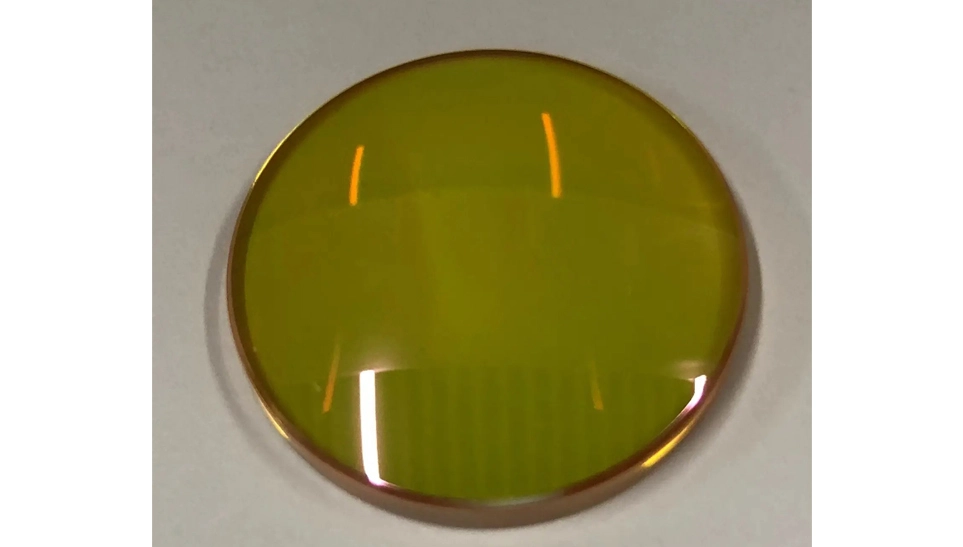
Choosing between an MWIR lens and an LWIR lens depends primarily on the target temperature, required detection range, detector technology, environmental conditions, and overall system cost.
MWIR systems typically operate in the 3–5 μm spectral band and are widely used in cooled, high-performance thermal imaging systems where sensitivity, long-range observation, and high-temperature target detection are important. LWIR systems generally operate around 8–12 μm or 8–14 μm and are commonly selected for imaging objects near ambient temperature, particularly when compact size, lower power consumption, and simpler system integration are priorities.
The right choice is therefore not simply which wavelength is “better,” but which optical band provides the best performance for the intended detector and application.
The primary difference is the wavelength range in which each system detects infrared radiation.
| Factor | MWIR | LWIR |
|---|---|---|
| Typical spectral range | 3–5 μm | 8–12 μm / 8–14 μm |
| Common detector configuration | Often cooled | Frequently uncooled |
| Typical target profile | Higher-temperature or demanding long-range targets | Objects near ambient temperature |
| System complexity | Higher | Usually lower for uncooled systems |
| Typical applications | Long-range surveillance, scientific imaging, industrial monitoring | Security, thermography, inspection, general thermal imaging |
MWIR and LWIR also correspond to different atmospheric transmission windows. Because detector response, atmospheric absorption, target temperature, and optical design all interact, wavelength selection has a significant effect on system-level performance.
Not universally.
An MWIR lens is often preferable when the system requires very high sensitivity, long focal lengths, precise target discrimination, or observation of relatively hot targets. This is why cooled MWIR systems are frequently used for long-range surveillance, target acquisition, scientific research, and demanding industrial applications. CNGEIR's cooled MWIR lens range, for example, includes manual, athermalized, and continuous-zoom configurations intended for high-performance infrared imaging systems.
An LWIR lens, however, is often a better match for compact uncooled thermal cameras. Uncooled LWIR detectors can operate near ambient temperature without a cryogenic cooler, which can reduce system size, weight, complexity, power requirements, and maintenance needs.
The appropriate comparison should therefore be made at the complete system level rather than by wavelength alone.
Cooling reduces detector-generated thermal noise.
Most high-performance MWIR cameras use photon detectors that benefit from operation at cryogenic temperatures. Lower detector temperature reduces unwanted thermal noise and allows weaker infrared signals and smaller thermal differences to be detected more effectively.
This is one reason cooled MWIR systems can provide excellent sensitivity and image quality in demanding imaging applications.
The trade-off is additional engineering complexity. A cryogenic cooler adds size, weight, power consumption, cost, startup considerations, and maintenance requirements.
For an optical system designer, this also means that selecting an MWIR lens requires more than matching focal length. The lens should be designed around parameters such as:
detector format and pixel pitch
spectral response
focal length and field of view
F-number
cold shield compatibility
back focal distance
operating temperature
focus or zoom requirements
These parameters are especially important when integrating custom optics with a cooled detector.
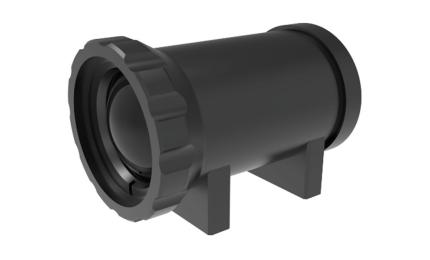
An MWIR lens is a strong candidate when performance is more important than minimum system cost or size.
Long-range systems usually require a combination of sufficient focal length, aperture, detector sensitivity, optical quality, and atmospheric transmission.
A cooled MWIR camera can be especially useful when the objective is not merely detecting that a target exists, but obtaining enough spatial information for recognition or identification at greater distances.
CNGEIR offers cooled MWIR options ranging from fixed/manual-focus optics to continuous zoom lenses such as 15–300 mm and 35–700 mm configurations, illustrating the type of focal-length range used in demanding observation systems.
MWIR is well suited to many applications involving elevated-temperature sources, such as industrial process monitoring, furnaces, engines, and other thermally energetic targets.
However, wavelength selection for temperature measurement should also consider emissivity, detector response, filters, atmospheric effects, and the exact temperature range rather than relying on target temperature alone.
For applications requiring very small temperature differences to be resolved, a cooled detector may provide significant advantages. Thermal sensitivity is commonly specified using NEDT; lower NEDT represents the ability to distinguish smaller thermal differences.
An LWIR lens is often preferred when the system must detect thermal radiation from objects close to normal environmental temperatures while maintaining low SWaP—size, weight, and power.
Typical applications include:
security monitoring
building inspection
predictive maintenance
firefighting
handheld thermal imaging
vehicle vision
general industrial thermography
One of LWIR's major practical advantages is its compatibility with widely used uncooled microbolometer detectors. Because these detectors do not require cryogenic cooling, the complete camera can usually be made smaller and simpler.
For high-volume or continuously operating systems, this difference can significantly influence procurement cost, power architecture, mechanical design, and lifecycle maintenance.
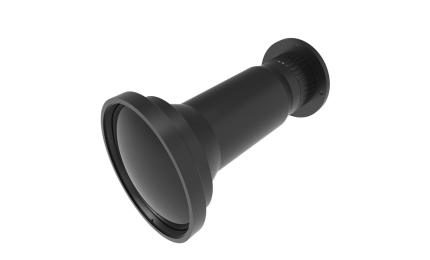
Yes. An MWIR lens and an LWIR lens should be optimized for their intended spectral band.
Infrared optical materials and anti-reflection coatings behave differently across wavelength ranges. For example, commercial infrared optics are offered with different coatings optimized specifically for 3–5 μm MWIR, 8–12 μm LWIR, or broader infrared ranges.
This is why a lens should not be selected simply because its focal length and mechanical dimensions fit the camera.
Professional optical matching should include:
Spectral transmission: The optical materials and coatings must provide adequate transmission across the detector's operating band.
F-number: The lens aperture should match the detector and system sensitivity requirements.
Detector size and pixel pitch: These determine the required image circle, field of view, and optical resolution.
Temperature compensation: Infrared optics can shift focus as temperature changes. Athermal lens designs can compensate for environmental temperature variation without continuous manual refocusing.
Focus and zoom mechanism: Fixed-focus, manual-focus, motorized-focus, or continuous-zoom architectures should be selected according to operating range and platform requirements.
The answer depends on much more than wavelength.
Detection range is influenced by detector sensitivity, focal length, aperture, pixel pitch, target size, target-background temperature difference, atmospheric conditions, and the criteria used for detection, recognition, or identification. Teledyne FLIR recommends first defining what must be observed, at what distance, and how much target detail is required.
For high-performance long-range systems, cooled MWIR is frequently selected because it combines high detector sensitivity with optics designed for demanding surveillance applications.
However, it would be incorrect to conclude that MWIR will always provide a greater range than LWIR. Atmospheric humidity, temperature, target characteristics, optical aperture, and detector performance can change the result considerably.
Start with the application rather than the lens specification.
Before requesting an infrared lens, system integrators should define:
Detector spectral band: MWIR or LWIR.
Detector resolution and pixel pitch: These determine optical resolution requirements.
Required detection, recognition, or identification distance: These affect focal length selection.
Field of view: Wide-area monitoring and long-range identification require different optical designs.
F-number: Critical for balancing energy collection, optical performance, and detector compatibility.
Operating temperature: Important when deciding whether an athermalized design is necessary.
Fixed or zoom optics: Continuous zoom can provide both wide-area search and narrow-field target observation.
Mechanical interface: Back focal distance, mounting dimensions, and available system volume must be considered during integration.
For custom infrared projects, providing these parameters to the lens manufacturer early in the design stage can reduce integration problems and prevent an otherwise high-performance detector from being limited by unsuitable optics.
The choice between an MWIR lens and an LWIR lens should be driven by the complete imaging requirement.
MWIR is particularly valuable for cooled, high-sensitivity systems used in long-range surveillance, precision imaging, scientific applications, and higher-temperature industrial observation. LWIR is often the more practical choice for compact uncooled thermal cameras monitoring targets near ambient temperature.
Most importantly, wavelength is only one part of infrared system design. Detector format, pixel pitch, F-number, focal length, optical materials, environmental temperature, atmospheric conditions, and required target range must all be considered together.
For demanding cooled MWIR systems, selecting an optical configuration that is specifically matched to the detector and application is essential for achieving the expected performance.
 Call us on:
  Email Us:
  No.9 Zhongxing East Road, Lishui Economic Development Zone, Nanjing, Jiangsu, China
  en
en