Choosing the right night vision headgear starts with one question: what will you actually do while wearing it? For mobile observation, patrol, search operations, wildlife monitoring, security, or extended outdoor use, image quality alone is not enough. Weight, field of view, mounting stability, battery endurance, low-light performance, and user comfort directly affect how useful the system will be in the field.
For users who need maximum flexibility with lower head-mounted weight, a night vision monocular head mount system is often the practical choice. For users who prioritize two-eye viewing, spatial awareness, and extended observation, head-mounted goggles or binocular configurations may be more appropriate. CNGEIR currently offers monocular, head-mounted goggle, and binocular night vision configurations for different operational requirements.
The most important factors are low-light image performance, optical configuration, weight, mounting compatibility, field of view, power supply, environmental durability, and ergonomic adjustment.
A professional buyer should evaluate the complete system rather than focusing on a single specification.
Low-light performance. Determine whether the device can provide a usable image under the actual illumination conditions of your application. Ambient starlight, moonlight, urban lighting, vegetation, weather, and supplemental infrared illumination can all affect practical viewing performance. CNGEIR notes that effective viewing distance varies according to night vision technology, ambient conditions, magnification, and environmental factors.
Optical quality. Evaluate resolution, image uniformity, edge distortion, focusing range, diopter adjustment, and field of view. For image-intensifier-based equipment, tube quality is especially important because it strongly affects brightness, contrast, noise, and useful service life. CNGEIR states that the intensifier tube is a critical component in determining the overall operating lifespan of this type of night vision equipment.
Ergonomics. A technically excellent device can still perform poorly in actual use if it creates excessive front-heavy load or requires frequent readjustment. Weight distribution becomes increasingly important during extended operation. Current night vision buying guidance similarly highlights total weight, helmet balance, eye relief, and counterweight requirements as important considerations for head-mounted systems.
Neither configuration is universally better. The correct choice depends on mobility, viewing duration, weight restrictions, and the level of visual comfort required.
A night vision monocular head mount is attractive when compact size and reduced weight are priorities. Because only one optical channel is positioned in front of the eye, the overall system can also be simpler to carry and configure. It is well suited to users who alternate between observation and other tasks.
Binocular or dual-eye night vision generally provides a more natural viewing experience during prolonged observation. It can be preferable when the user needs to move frequently in darkness or maintain visual awareness for extended periods. The trade-off is usually additional weight, greater power requirements, and increased sensitivity to helmet balance.
Buyers should also clarify whether a product described as “goggles” uses one optical channel distributed to two eyepieces or independent channels for each eye. These architectures can differ significantly in cost, weight, image presentation, and overall performance.
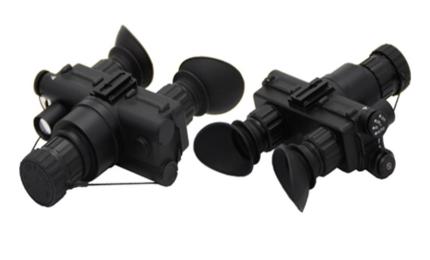
For equipment intended primarily for walking, navigation, or other mobile hands-free applications, 1× magnification is generally the most practical configuration because the visual scale remains close to natural eyesight. Commercial head-mountable night vision products commonly use 1× configurations for this reason.
Higher magnification can be useful when the primary task is distant observation, but it may narrow the field of view and make movement less comfortable. If long-distance identification is more important than mobility, a dedicated handheld monocular or binocular may therefore be a better solution than permanently adding magnification to headgear.
The key is to match magnification to operating distance rather than assuming that a larger number automatically means better performance.
It depends on the technology.
Image-intensifier systems amplify available light, so their performance improves when some ambient light is present. In environments with extremely little usable light, an infrared illuminator can provide additional illumination that compatible night vision equipment can detect.
Digital night vision systems can also use active infrared illumination. Commercial head-mounted systems frequently offer compatible IR illuminators for improving visibility when natural light is insufficient.
This means buyers should not evaluate a device simply by asking how far it can “see in the dark.” A more useful question is how it performs under the lowest illumination level expected in the actual application.
They are critical for any application involving long periods of hands-free use.
The device, mounting interface, helmet or head harness, battery configuration, and optional accessories all contribute to total system weight. Even a relatively small increase at the front of the helmet can become noticeable after extended use.
Mount compatibility should therefore be confirmed before purchase. Buyers should check the mounting interface, adjustment range, vertical position, eye relief, flip-up mechanism, and whether additional adapters are required. Night vision industry buying guides specifically identify head balance and mount configuration as key considerations for practical use.
A stable mount should hold the optical axis consistently in front of the user's eye without requiring repeated adjustment during movement.
Service life depends heavily on the underlying technology, component quality, operating environment, and maintenance.
For image-intensifier-based systems, the tube is normally one of the most important lifetime components. CNGEIR notes that high-quality intensifier tubes may provide approximately 10,000–15,000 hours of active operation under appropriate use and maintenance, while excessive bright-light exposure and rough handling can reduce service life.
Mechanical durability is equally important. Professional buyers should evaluate housing quality, lens protection, connectors, switches, mounting components, moisture resistance, and the availability of replacement parts.
Price should not be the first qualification criterion.
When sourcing from a night vision goggles manufacturer, ask for detailed specifications, product configuration information, quality-control procedures, sample availability, warranty terms, technical support, and customization capability.
For companies sourcing China night vision products, it is particularly important to compare products on measurable specifications rather than broad terms such as “high performance” or “long range.” Viewing distance should always be considered together with target size, ambient illumination, weather, optical configuration, and image-processing technology. CNGEIR itself notes that effective range changes with environmental and technical conditions rather than remaining a fixed value in every situation.
For OEM or project-based procurement, buyers should also confirm mechanical interfaces, electrical requirements, optical specifications, environmental requirements, expected order quantities, and customization needs before finalizing a configuration.
The best night vision headgear is not necessarily the system with the highest specification on paper. It is the one that delivers the right balance of image quality, field of view, weight, mounting stability, operating time, and environmental performance for the intended application.
A lightweight night vision monocular head mount may be the better option for mobility and flexible observation, while head-mounted goggles or binocular systems can offer a more comfortable two-eye viewing experience for extended use.
For professional procurement, working with an experienced night vision goggles manufacturer can also help ensure that optical performance, mounting design, environmental requirements, and customization are matched to the real application instead of selecting equipment based on specifications alone.
Not always. Many systems can work with available ambient light, while an IR illuminator can improve performance in extremely dark environments.
Yes. For walking and hands-free movement, 1× is usually preferable because it maintains a more natural visual scale.
Ask about optical specifications, low-light performance, weight, mounting compatibility, battery life, environmental protection, quality control, warranty, and customization options.
Ambient light, target size, optics, night vision technology, magnification, weather, and infrared illumination can all affect effective viewing distance.
 Call us on:
  Email Us:
  No.9 Zhongxing East Road, Lishui Economic Development Zone, Nanjing, Jiangsu, China
  en
en