In high-performance imaging systems—whether used in surveillance, marine observation, UAV payloads, or thermal and infrared detection—the optical dome lens plays a critical role. A dome is not just a protective shell; it directly influences imaging clarity, angular coverage, transmission efficiency, and long-term durability. Selecting the right optical dome lens requires a careful balance between materials, manufacturing precision, environmental resistance, and system-level optical performance.
At CNGEIR, where advanced optical engineering and ruggedized imaging solutions are core strengths, the demand for high-quality domes continues to rise. This article offers a practical, engineering-driven guide to help system designers, integrators, and procurement engineers make informed decisions.
An optical dome lens differs from a conventional lens element in both geometry and function. Instead of focusing light, the dome serves two primary purposes:
Provide a protective barrier for internal sensors and optics
Enable wide-angle imaging without distorting incoming light rays
A well-designed dome allows sensors—visible, NIR, SWIR, MWIR, or LWIR—to operate at full performance across extreme angles of incidence. This is why domes are commonly used in:
Gimbal systems and PTZ cameras
Marine and underwater imaging
Thermal and IR surveillance platforms
Airborne and ground-based reconnaissance devices
THE KEY: Any surface imperfection, stress, or refractive mismatch in the dome directly affects the image. Choosing correctly ensures system reliability and optical integrity.
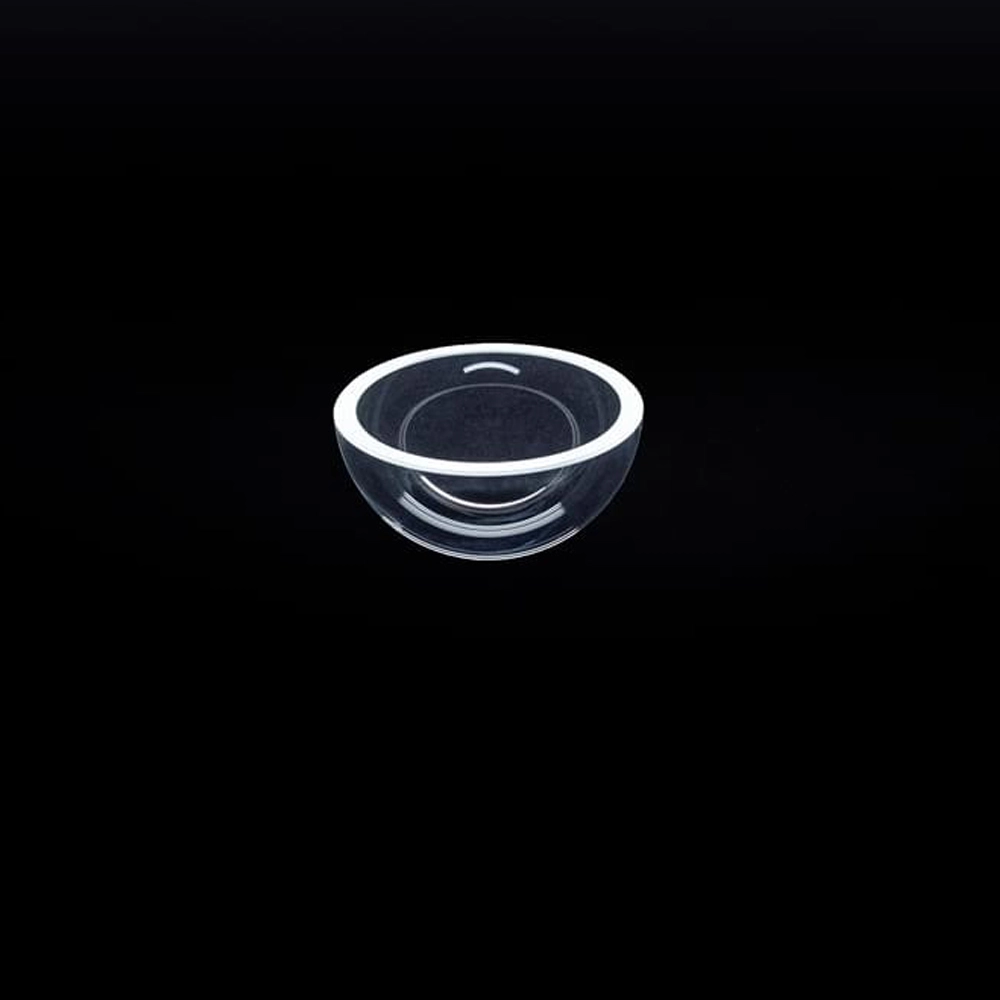
Material selection is the foundation of dome design. Each application demands a dome material with the right combination of durability, transmission, and thermal characteristics.
Below is a comparison of common materials used in optical dome lens manufacturing:
| Material | Benefits | Typical Applications |
|---|---|---|
| Fused Silica | High transmission, excellent thermal stability | High-precision visible/NIR imaging, aerospace |
| Sapphire | Extreme hardness, high scratch resistance, wide spectral band | Harsh environments, marine, defense |
| Germanium | Excellent LWIR transmission, good machinability | Thermal imaging, infrared targeting |
| ZnS / ZnSe | High IR transmission, lightweight | MWIR/LWIR sensors, UAV payloads |
| Acrylic / Polycarbonate | Low cost, high impact resistance | Consumer devices, wide-angle housings |
For harsh tactical or industrial environments, CNGEIR often recommends sapphire or germanium domes due to their combination of optical performance and ruggedness.
The geometry of an optical dome lens determines how rays pass through the surface. Unlike flat windows, domes must preserve the angle of incidence for wide-FOV sensors.
Key parameters include:
Radius of curvature
Wall thickness uniformity
Apex precision
Optical symmetry
Poor geometry results in:
Astigmatism
Coma distortions
Resolution loss at the image periphery
This is especially critical for systems that mount sensors behind the dome at varying pan-tilt angles—such as UAV gimbals or marine camera turrets. CNGEIR’s precision CNC and optical polishing processes ensure minimal refractive deviation, which maintains image fidelity across the full field of view.
A dome is often the first component exposed to harsh conditions, so durability is a key buying factor.
Consider the following environmental requirements:
Abrasion resistance (sand, salt spray, debris)
Pressure resistance (for underwater domes)
Thermal shock tolerance
Chemical resistance
Anti-fog, anti-reflection, or hydrophobic coatings
For example:
Sapphire domes excel in extreme abrasion and offer long service life.
Germanium domes, despite excellent IR performance, require anti-reflection coatings to reduce reflection loss.
CNGEIR offers specialized coating options tailored to each material and application environment, ensuring stable imaging even under mission-critical conditions.
Coatings significantly affect the transmission and durability of an optical dome lens. Depending on the wavelength band and operating environment, the right coating can dramatically improve output image quality.
Common coatings include:
AR (anti-reflection) coatings for visible, NIR, MWIR, or LWIR
DLC (diamond-like carbon) coatings for scratch and abrasion resistance
Hydrophobic/oleophobic layers for moisture and oil repellence
Broadband multilayer coatings for multi-spectral systems
For LWIR thermal imaging, CNGEIR often recommends:
"AR/DLC" dual-layer coating
Ensures high infrared transmission
Provides battlefield-level surface hardness
Choosing the wrong coating can degrade image quality or reduce dome lifespan, so matching coating types to spectral and environmental needs is essential.
A high-quality dome must be compatible with the system’s mechanical and optical design. Key considerations include:
Dome mounting method
Internal clearance for pan-tilt systems
Refractive index compatibility with downstream lenses
Thermal expansion alignment
Weight limits for UAV platforms
For wide-angle or rotating systems, even slight misalignment can create image warping. CNGEIR’s engineers typically work with customers to ensure the dome’s optical path is optimized for the full mechanical range of motion.
CNGEIR has established a strong reputation in the precision optics industry by focusing on:
High-precision dome manufacturing
Advanced polishing and shaping technologies
Strict optical surface quality standards
Full-spectrum coating capabilities
Custom engineering support for complex imaging systems
From prototyping to mass production, CNGEIR’s solutions support imaging systems used in security, defense, marine observation, UAV platforms, and industrial monitoring.
Choosing the right optical dome lens is a critical step that directly influences the long-term performance and reliability of your imaging system. By evaluating material properties, geometry, coating options, environmental requirements, and integration needs, system designers can ensure their optics function at peak performance under demanding conditions.
For organizations seeking durable, precision-engineered dome solutions, CNGEIR provides technical expertise, custom manufacturing capabilities, and proven optical quality that support mission-critical applications worldwide.
 Call us on:
  Email Us:
  No.9 Zhongxing East Road, Lishui Economic Development Zone, Nanjing, Jiangsu, China
  en
en